We had a major task ahead of us – we had to carry out research into the transport sector. It was quite an extensive study, as it was cross-sectional in nature: it covered drivers, small transport firms and larger logistics companies, as well as independent specialists.
We began by conducting in-depth interviews (IDIs) with drivers. I didn’t want to use an agency, so we hit the road. We went round car parks and asked drivers if they’d be willing to be interviewed. They were usually very friendly and, surprisingly, keen to talk.
Target groups – drivers
Goal
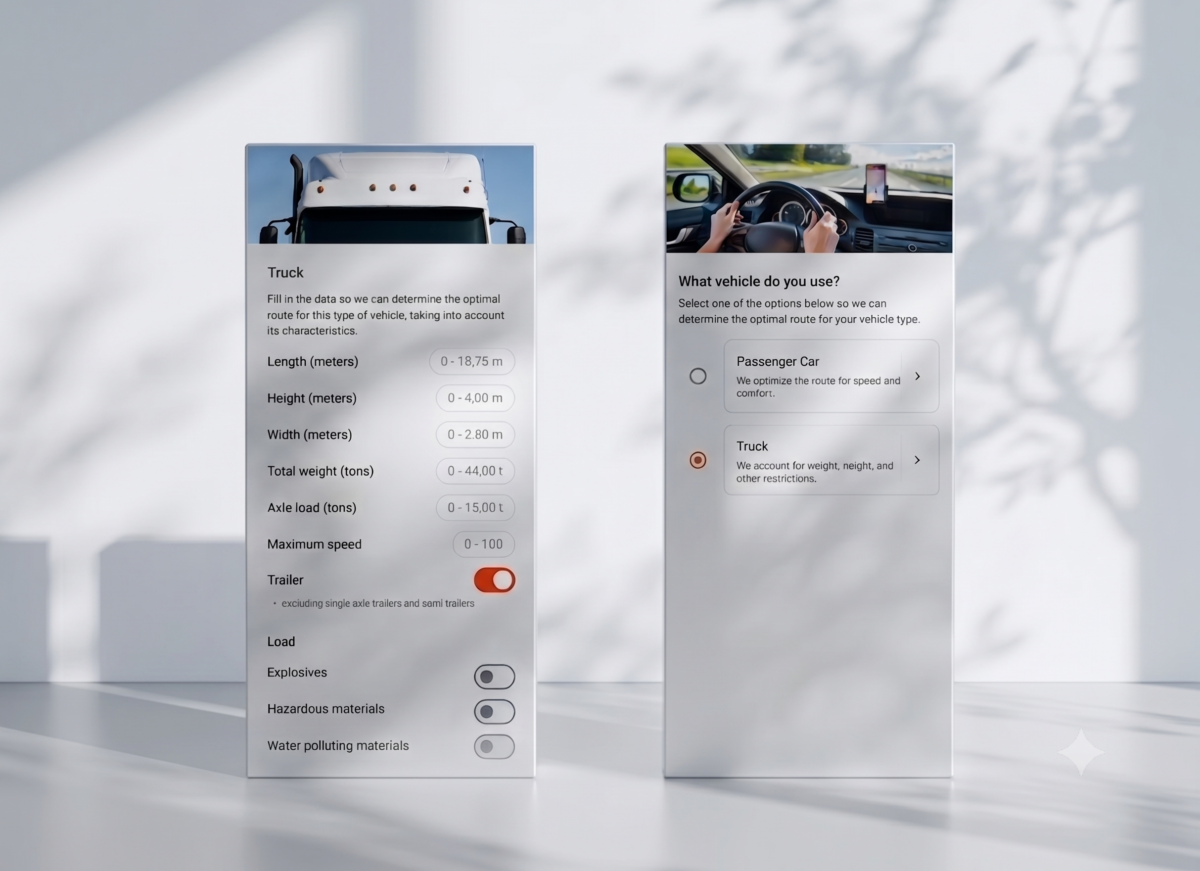
- Defining the key features of lorry navigation.
- Identifying the problems drivers face that are not addressed by existing solutions
Survey categories:
- Experienced long-haul drivers (5 people) – driving mainly on fixed international routes.
- Experienced local driver (1 person) – operating within the region (Wielkopolska/Poznań) on regular routes.
- Owner of a small haulage company (1 person) – managing a fleet of ~15 vehicles on a variety of routes both domestically and abroad.
Conclusion
Respondents
Experienced long-haul drivers (5 people), mainly driving regular international routes.
An experienced local driver (1 person) – covering the region (Wielkopolska/Poznań) on regular routes.
The main conclusion was that the drivers still had a lot of problems with finding the most important information about weight limits, bridge heights and road accessibility for heavy goods vehicles. This information is simply out of date or changes too quickly, given the number of roadworks in Poland. What’s more, it turned out that every country has its own specific issues when it comes to problems on the road.
The second important issue was lorry parking areas. We had the opportunity to gather information about the specific needs of lorry drivers on the roads. In Europe, it is rare to find good parking areas with sufficient spaces and facilities such as a shop, showers or security. In fact, Poland has some of the best facilities of this kind.
One of the most important observations was that, in reality, they do not rely heavily on navigation apps. Quite the opposite, in fact. They usually rely on their own experience and knowledge that is difficult to convey, such as intuition or expertise in specific areas.
Target group – transport companies
- Characteristics: large-sized transport company
- Routes and coverage: different routes every day, international
- Staff profile: a stable workforce
Characteristics:
- The order of stops is often dictated by the customer, but the driver may suggest a change if they see a better solution.
- Drivers’ knowledge and experience are highly valued – their suggestions regarding routes, the order of loads or detours are often taken into account.
- Fixed routes are only used for high-value cargo, in accordance with customer requirements
During the interview, a great deal of interesting information came to light, along with a number of challenges. It turned out that, despite a highly advanced system, there are still problems with communication with drivers. The quickest way is always a phone call, but information and changes to routes and schedules remain outside the system. Some drivers prefer to send messages via text or various messaging apps. Before long, information is circulating through various channels and it becomes difficult to keep track of it.
Another issue is that so many factors arise during the course of the day that 50 per cent of the original plan ends up changing. No system is capable of coping with this – only highly qualified staff who are able to handle dozens of orders at the same time.
Interview with an expert
Finally, we had the opportunity to speak to an expert in this field. His vast knowledge allowed us to look at the issue from a broader perspective. We are currently going through a period of transformation, and the industry is facing many challenges. First, we need to work out how to tackle the shortage of drivers and how to maintain the competitiveness of services.